AI Course
What is AI Ethics?
AI Ethics is the study and practice of ensuring that AI systems are designed, developed, and used in ways that are fair, safe, transparent, and beneficial — while minimizing harm to individuals and society. As AI tools become more capable and widely used, understanding these principles is essential for building and using AI responsibly.
Why AI Ethics matters
- AI systems are increasingly involved in decisions that affect real people — hiring, lending, healthcare, law enforcement, and more.
- AI models learn from data created by humans, which means they can inherit and amplify existing societal biases if left unchecked.
- Trust in AI systems depends on them being used responsibly, transparently, and with appropriate human oversight.
Core principles of responsible AI
- Fairness — AI systems should treat individuals and groups equitably, without discriminating based on characteristics like race, gender, age, or other protected attributes.
- Transparency — Users should be able to understand, to a reasonable degree, how and why an AI system produced a given output or decision.
- Accountability — There should be clear responsibility for the outcomes of AI systems — organizations and individuals deploying AI remain accountable for its effects.
- Privacy — AI systems should respect data privacy, using personal information responsibly and with appropriate consent.
- Safety and reliability — AI systems should be tested and monitored to reduce the risk of harmful, inaccurate, or unpredictable behavior.
- Human oversight — Humans should remain involved in reviewing and validating AI-driven decisions, especially in high-stakes contexts.
What is Bias in AI?
Bias in AI refers to systematic errors in a model's output that unfairly favor or disadvantage certain individuals or groups. Bias typically originates from the data or design choices used to build the model, rather than the AI "deciding" to be unfair.
Common sources of bias
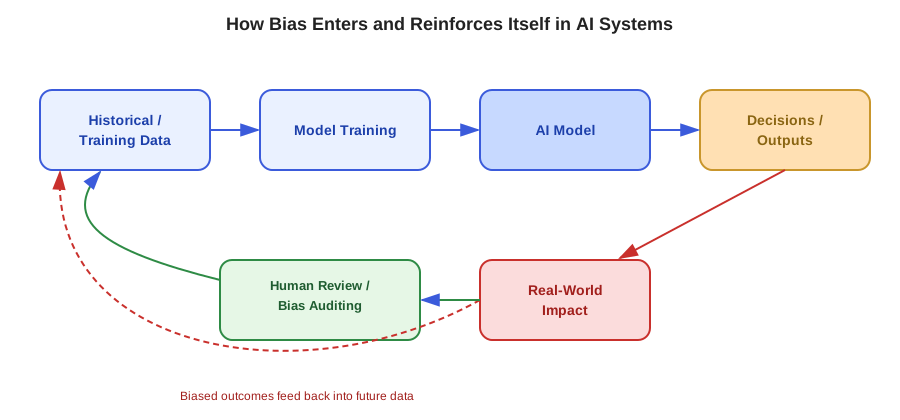
- Training data bias — If the data used to train a model reflects historical or societal biases, the model can learn and reproduce those same patterns.
- Example: A hiring model trained on historical hiring data may learn to favor candidates similar to those hired in the past, even if that past pattern was itself biased.
- Sampling bias — When training data isn't representative of the full population the model will be used on.
- Example: A facial recognition model trained mostly on images of one demographic may perform less accurately on others.
- Labeling bias — When the humans labeling training data introduce their own subjective biases into the labels.
- Feedback loop bias — When a model's biased outputs influence future data, which is then used to train later versions of the model — reinforcing the original bias over time.
Real-world impact of AI bias
- Hiring — Resume-screening tools that unintentionally disadvantage certain demographic groups.
- Lending and credit — Credit-scoring models that produce less favorable outcomes for certain populations due to biased historical data.
- Healthcare — Diagnostic tools that perform less accurately for underrepresented groups in the training data.
- Law enforcement — Predictive policing or facial recognition tools that disproportionately misidentify certain groups.
Strategies to reduce bias and act responsibly
- Diverse, representative data — Use training data that reflects the full diversity of the population the model will serve.
- Bias testing and auditing — Regularly test model outputs across different groups to identify and address disparities.
- Human review — Keep humans in the loop for high-stakes decisions, rather than relying on AI output alone.
- Transparency in limitations — Clearly communicate what a model can and cannot reliably do, and where its outputs should be treated with caution.
- Ongoing monitoring — Continue evaluating a model's real-world performance after deployment, since bias can emerge or shift over time.
Other key ethical considerations
- Privacy — Ensuring AI systems handle personal and sensitive data responsibly, with appropriate safeguards and consent.
- Misinformation — Generative AI's ability to produce convincing but false content (text, images, or video) raises concerns about misinformation and "deepfakes."
- Intellectual property — Questions around ownership and originality when AI-generated content is based on patterns learned from existing copyrighted works.
- Job impact — Considering how automation and AI augmentation affect roles, responsibilities, and the workforce.
- Environmental cost — Training and running large AI models consumes significant energy and computing resources.
Why this matters in practice
Understanding AI ethics and bias helps in recognizing:
- Why AI-generated or AI-assisted decisions should always be reviewed, especially in high-stakes situations.
- Why the quality and diversity of training data directly affects how fair and reliable a model's output is.
- Why "the AI said so" is never sufficient justification for a decision — accountability always remains with the people and organizations deploying the system.
- How responsible AI use is not a one-time checkbox, but an ongoing practice of testing, monitoring, and human oversight throughout a model's lifecycle.