Back to AI Course
AI Course
What is Computer Vision?
Computer Vision (CV) is a field of AI focused on enabling computers to "see" — to interpret, analyze, and understand visual information from the world, such as images and video, in a way that mimics human visual perception.
Where Computer Vision fits in the bigger picture
- Artificial Intelligence (AI) — The broadest field: building systems that perform tasks associated with human intelligence.
- Machine Learning (ML) — A subset of AI: systems that learn patterns from data.
- Deep Learning (DL) — A subset of ML: uses layered neural networks to learn from large datasets.
- Computer Vision (CV) — An application area that uses ML and Deep Learning techniques (especially Convolutional Neural Networks) specifically to work with visual data.
Core tasks Computer Vision handles
- Image classification — Assigning a label to an entire image (e.g., identifying whether a photo contains a "cat" or a "dog").
- Object detection — Identifying and locating multiple objects within an image, typically by drawing bounding boxes around them.
- Image segmentation — Dividing an image into regions or pixel-level areas, identifying exactly which pixels belong to which object.
- Facial recognition — Identifying or verifying a person's identity based on facial features.
- Optical Character Recognition (OCR) — Extracting readable text from images, scanned documents, or photos.
- Image generation — Creating new, original images from a text description or another image.
- Video analysis — Tracking motion, detecting activity, or recognizing events across a sequence of video frames.
How a computer "sees" an image
Computers don't perceive images the way humans do — an image is really just a grid of numbers to a model:
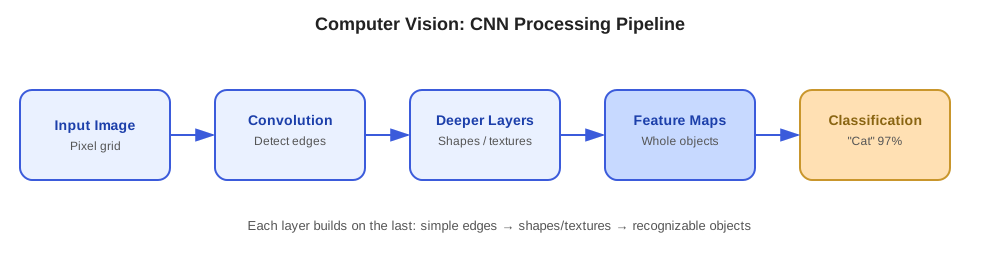
- Pixels as data — Every image is made up of pixels, each represented by numerical values (e.g., intensity values for red, green, and blue channels).
- Feature extraction — A model, typically a Convolutional Neural Network (CNN), scans the image in small sections to detect low-level features first (like edges and colors), then combines them into more complex features (like shapes, textures, and eventually whole objects) as data passes through deeper layers.
- Classification/output — The final layers of the network use the extracted features to produce an output, such as a predicted label or the coordinates of a detected object.
Convolutional Neural Networks (CNNs)
- CNNs are the deep learning architecture most commonly used for Computer Vision tasks.
- They use a mathematical operation called convolution to scan across an image with small filters, detecting local patterns like edges, corners, and textures.
- As data passes through multiple convolutional layers, the network builds an increasingly abstract understanding of the image — from simple edges to complete objects.
- CNNs are efficient at this because they reuse the same filters across the entire image, rather than learning separate patterns for every pixel position.
Why Computer Vision needs a lot of labeled data
- Most CV models are trained using supervised learning, requiring large datasets of images labeled by humans (e.g., millions of images tagged with the objects they contain).
- The quality, diversity, and volume of the labeled training data directly affects how accurately and fairly a CV model performs across different real-world conditions (lighting, angles, backgrounds, and populations of people or objects).
Real-world applications of Computer Vision
- Healthcare — Analyzing medical scans (X-rays, MRIs) to help detect abnormalities.
- Retail — Powering visual search, checkout-free stores, and inventory tracking.
- Autonomous vehicles — Detecting lanes, pedestrians, other vehicles, and road signs in real time.
- Manufacturing — Automated quality inspection to detect defects on production lines.
- Security — Surveillance systems using object and motion detection.
- Accessibility — Tools that describe images or scenes aloud for visually impaired users.
Common challenges in Computer Vision
- Bias in visual data — If training data lacks diversity (e.g., in skin tones, lighting conditions, or angles), models can perform unevenly across different groups or scenarios.
- Adversarial vulnerability — Small, sometimes imperceptible changes to an image can cause a model to misclassify it.
- Context and ambiguity — Visual scenes can be genuinely ambiguous (e.g., partially obscured objects), making accurate interpretation difficult.
- Privacy concerns — Technologies like facial recognition raise significant privacy and consent considerations, requiring careful, responsible use.
- Compute and data costs — Training accurate CV models typically requires large labeled datasets and significant computing power.
Why this matters in practice
Understanding Computer Vision basics helps in recognizing:
- How everyday tools — from photo search to face unlock on a phone — rely on the same underlying image-recognition techniques.
- Why CV models need large, diverse, and well-labeled datasets to work reliably and fairly across different real-world conditions.
- Why human oversight is important in high-stakes CV applications, like medical imaging or security, where an incorrect prediction can have serious consequences.
- How Computer Vision fits into the broader AI landscape: a specialized application of Deep Learning focused specifically on interpreting visual data.