AI Course
What is Deep Learning?
Deep Learning is a specialized subset of Machine Learning that uses layered structures called neural networks to learn from large amounts of data. It is called "deep" because these networks are made up of many stacked layers, each learning increasingly complex patterns from the data passed through it.
Deep Learning is the technology behind most modern generative AI tools — including large language models (LLMs), image generators, and speech recognition systems.
How Deep Learning fits into the bigger picture
- Artificial Intelligence (AI) — The broadest field: building systems that perform tasks associated with human intelligence.
- Machine Learning (ML) — A subset of AI: systems that learn patterns from data.
- Deep Learning (DL) — A subset of ML: uses multi-layered neural networks to learn from especially large and complex datasets.
What is a Neural Network?
A neural network is a model structure loosely inspired by the human brain, made up of layers of connected "nodes" (also called neurons):
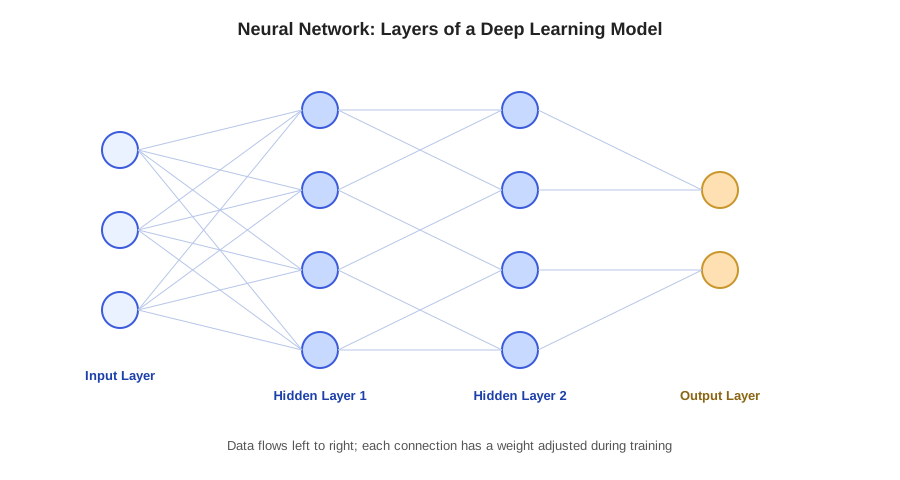
- Input layer — Receives the raw data (e.g., pixels of an image, or words in a sentence).
- Hidden layers — One or more layers in between, where the network progressively learns patterns and features from the data. "Deep" networks have many hidden layers.
- Output layer — Produces the final result (e.g., a predicted label, a generated word, or a classification).
Each connection between nodes has a weight, which the network adjusts during training to improve its predictions. This adjustment process is guided by comparing the network's output to the correct answer and correcting the error — a process often called backpropagation.
Why Deep Learning needs so much data and computing power
- Deep neural networks often have millions or even billions of parameters (weights) to adjust during training.
- Training requires large, high-quality datasets so the network can learn robust, generalizable patterns rather than memorizing specific examples.
- Specialized hardware (like GPUs and TPUs) is typically used to handle the intense computation involved in training deep networks efficiently.
Common types of Deep Learning models
- Convolutional Neural Networks (CNNs) — Especially effective for image and video data; commonly used for image recognition and computer vision tasks.
- Recurrent Neural Networks (RNNs) — Designed to handle sequential data, like time series or text, by retaining memory of previous inputs.
- Transformers — The architecture behind most modern large language models (like Gemini). Transformers are especially good at understanding context and relationships across long sequences of text, which is why they power today's most capable generative AI tools.
Deep Learning vs. traditional Machine Learning
- Feature engineering
- Traditional ML: Often requires humans to manually identify and select the relevant features in the data.
- Deep Learning: Automatically learns relevant features directly from raw data, reducing the need for manual feature engineering.
- Data requirements
- Traditional ML: Can perform well with smaller datasets.
- Deep Learning: Generally requires large volumes of data to perform well.
- Complexity of patterns
- Traditional ML: Better suited to simpler, more structured problems.
- Deep Learning: Better suited to complex, unstructured data like images, audio, and natural language.
Common challenges in Deep Learning
- Data and compute cost — Training deep models can require significant amounts of data and computing resources.
- Explainability — Deep neural networks are often described as "black boxes," since it can be difficult to interpret exactly why a model produced a particular output.
- Overfitting — A deep model can learn the training data too precisely, including its noise and quirks, which hurts performance on new, real-world data.
- Bias amplification — Because deep models learn heavily from their training data, any bias present in that data can be learned and reinforced at scale.
Why this matters in practice
Understanding Deep Learning basics helps in recognizing:
- Why generative AI tools (like chatbots and image generators) can produce such fluent, contextually relevant output — it's the layered pattern-learning of deep neural networks at work.
- Why these tools require enormous datasets and computing power to train.
- Why output still needs human review — deep learning models can be highly capable, but their internal reasoning isn't always transparent or easily explainable.
- How Deep Learning relates back to the broader picture: it's a specialized, data-hungry approach within Machine Learning, which itself is a subset of AI.