AI Course
What is Generative AI?
Generative AI is a type of Artificial Intelligence that creates new, original content — text, images, audio, video, or code — rather than simply analyzing or classifying existing data. It learns the underlying patterns, structures, and styles present in its training data, then uses that understanding to generate new content that resembles it.
Where Generative AI fits in the bigger picture
- Artificial Intelligence (AI) — The broadest field: building systems that perform tasks associated with human intelligence.
- Machine Learning (ML) — A subset of AI: systems that learn patterns from data.
- Deep Learning (DL) — A subset of ML: uses layered neural networks to learn from large datasets.
- Generative AI — An application of Deep Learning that focuses specifically on creating new content, rather than just recognizing or classifying existing content.
How Generative AI is different from other AI
- Discriminative/predictive AI — Answers questions like "What is this?" or "What will happen next?" (e.g., classifying an email as spam, predicting a patient outcome).
- Generative AI — Answers a different kind of question: "What new content could plausibly come next, or fit this description?" (e.g., writing a paragraph, drawing an image, composing a melody).
Both types are built using similar ML/DL foundations, but generative models are specifically trained to produce new output rather than a label or classification.
Common types of Generative AI models
- Large Language Models (LLMs) — Built on the Transformer architecture; generate coherent text, answer questions, summarize documents, and write code (e.g., Gemini).
- Diffusion models — Commonly used for image generation; they work by learning to gradually remove "noise" from a random starting point until a coherent image emerges.
- Generative Adversarial Networks (GANs) — Use two competing neural networks — a "generator" that creates content and a "discriminator" that tries to detect whether it's real or generated — improving each other through competition.
- Multimodal models — Can understand and generate across multiple types of content at once (e.g., generating an image from a text prompt, or describing the contents of an image in words).
How Generative AI produces output
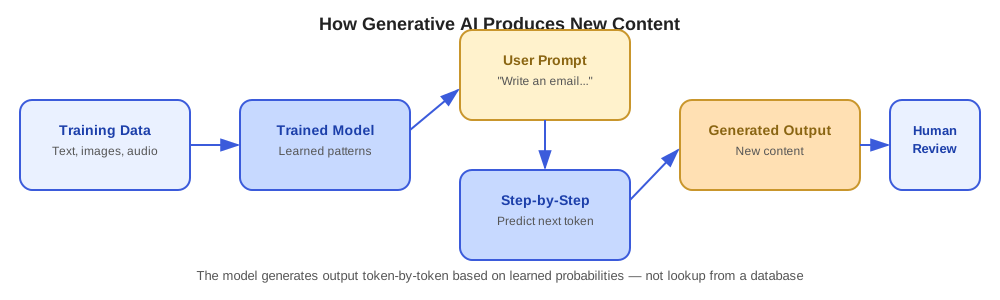
- Training — The model is trained on massive datasets (text, images, audio, etc.) to learn statistical patterns, structures, and relationships within the content.
- Prompting — A user provides an input (a prompt) describing what they want generated.
- Generation — The model predicts the most statistically likely next piece of content (the next word, pixel, or sound) step by step, based on patterns learned during training, until a complete output is produced.
Generative AI is not retrieving or copying answers from a database — it is generating new content based on probabilities learned from its training data. This is why output can vary between runs, even with the same prompt.
Common use cases
- Text — Drafting emails, summarizing documents, brainstorming ideas, writing and debugging code.
- Images — Creating illustrations, product mockups, or marketing visuals from a text description.
- Audio — Generating music, voiceovers, or synthetic speech.
- Video — Creating short video clips or animations from text or image prompts.
- Code — Generating boilerplate code, unit tests, or API specs based on natural language descriptions.
Human oversight with Generative AI
Because generative models produce new content rather than verified facts, human review remains essential:
- Review for accuracy — Generative AI can produce fluent, confident-sounding output that is factually incorrect (often called "hallucination").
- Review for tone and appropriateness — Generated content should be checked to ensure it matches the intended audience, tone, and context.
- Iterate on prompts — Refining and re-prompting is often necessary to get output that fully meets the actual need.
- Check for bias — Since models learn from existing data, generated content can reflect biases present in that training data.
Common challenges in Generative AI
- Hallucination — Generating plausible-sounding but false or fabricated information.
- Bias amplification — Reflecting or amplifying biases present in the training data.
- Intellectual property and originality — Questions around ownership and originality when content is generated based on patterns learned from existing copyrighted works.
- Compute cost — Training and running large generative models requires significant data and computing power.
- Consistency — The same prompt can produce different results across runs, which can make output harder to predict or rely on for precision-critical tasks.
Why this matters in practice
Understanding Generative AI basics helps in recognizing:
- Why tools like Gemini can draft emails, write code, and generate images — they're built on models specifically trained to create new content, not just analyze it.
- Why generated output should always be reviewed rather than used as-is, especially for factual accuracy.
- Why the way a prompt is written directly shapes the quality of the result.
- How Generative AI fits into the broader AI landscape: a specialized, content-creating application built on the same Deep Learning foundations used across the rest of AI.