AI Course
What is AI?
Artificial Intelligence (AI) is a broad field focused on building tools and systems that can complete tasks typically associated with human intelligence, such as recognizing patterns, making predictions, understanding language, and generating content.
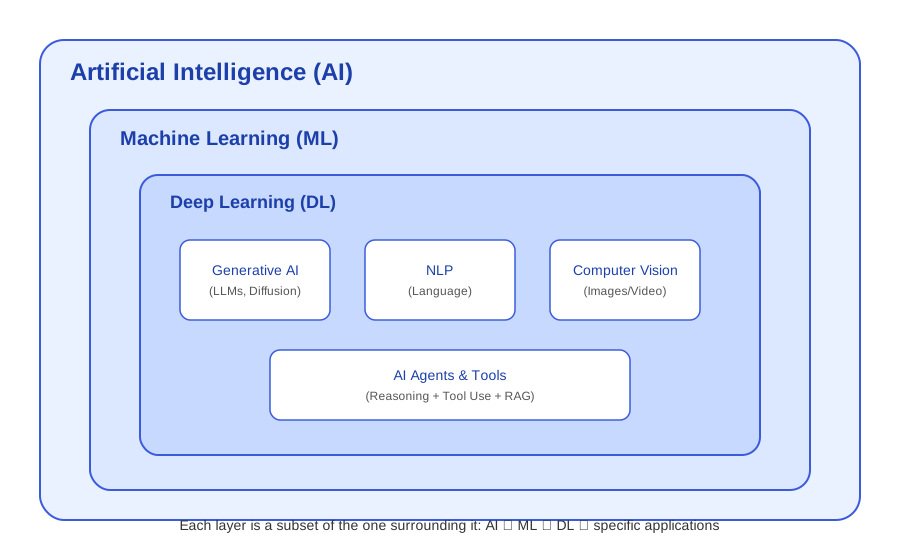
What is Generative AI?
Generative AI is a type of AI that can create new and original content, from text and images to music and code. It is powered by Machine Learning (ML).
How are AI and ML related?
Machine Learning (ML) is a specific technique that enables a tool to learn from data without being explicitly programmed for every possible scenario. ML is a subset of AI — it is the engine that powers many of today's generative AI tools.
Approaches to Machine Learning
There are three common ML approaches used to develop AI tools:
-
Supervised learning — Trains a tool using a massive dataset that has been labeled by humans. Used when there is a specific, known output in mind.
- Example: An image generator is trained on millions of pictures explicitly labeled "cat." ML enables the tool to recognize the features, patterns, and characteristics of cats so it can create new images of cats.
-
Unsupervised learning — Trains a tool using a dataset that has not been labeled by humans. Used to identify patterns and structures in data when there isn't a specific, known output in mind.
- Example: An image generator analyzes a large dataset of unlabeled animal photos. ML enables it to cluster images with similar features — like whiskers and pointy ears — learning what a "cat" looks like on its own, without human-provided labels.
-
Reinforcement learning — Trains a tool through a process of trial-and-error guided by feedback. Used to continuously refine and improve a tool's performance on a specific task.
- Example: After an image generator creates a picture of a cat, a human evaluator provides feedback. Positive feedback signals a successful output. This feedback is collected and used by developers to improve future versions of the tool.
Many of today's AI tools combine all three approaches to generate text, images, video, and more.
Important: This "learning" happens during the tool's development and training phase — before it's released to the public. Feedback and data collected from users help developers improve future versions, but the AI is not learning in real time as you use it.
Rule-based AI: a different approach
Not all AI is powered by machine learning. Rule-based AI tools operate using a set of hard-coded rules created by human developers, and do not learn from new data. They follow their specific instructions precisely, every time.
- Example: A simple customer service chatbot might be programmed with the rule: "If a user's message contains the phrase 'tracking number,' respond with a link to our package tracking website." The chatbot follows this rule consistently, but cannot adapt or understand requests outside its pre-written rules.
Rule-based AI is often used for predictable, narrow tasks in the workplace. It is far less flexible than machine learning, which allows AI tools to adapt and handle a wider range of complex, real-world data.
AI Automation vs. AI Augmentation vs. Replacement
- AI Automation — AI carries out a task independently, with little to no human involvement in the process itself.
- AI Augmentation — AI and humans work together: AI assists with a task (e.g., drafting content), and a human reviews, adjusts, and finalizes the output.
- Replacement — AI takes over a role or task entirely, eliminating the need for human involvement in that function.
Why human oversight matters
Even as AI tools become more capable, human oversight remains essential when AI is involved in decision-making. Human review ensures that:
- Decisions are made with ethical considerations and accountability.
- Biases present in training data are identified and corrected rather than perpetuated.
- AI-generated output is accurate, appropriate, and aligned with the intended goals — not just fast or cost-efficient.
Common challenges of using AI
- Bias — AI can perpetuate or amplify existing biases found in its training data.
- Staying current — AI systems often need continuous training on new data, procedures, or context to stay accurate and relevant over time.
- Over-reliance — Treating AI output as final without review can lead to errors going unnoticed, since AI is not learning or correcting itself in real time.
Knowledge Check
1. A health care company wants to use AI to predict patient outcomes after surgery. They provide the AI with a training set of historical patient data that contains details of previous surgical procedures and outcomes. What role does the training set play in this scenario?
- ✅ It teaches the AI to help predict patient outcomes after surgery.
- It is used to schedule future surgeries for patients.
- It suggests other procedures that might be relevant for patients.
- It serves as a database of patient contact information.
2. Which of the following tasks can a marketing agency accomplish using generative AI? (Select three answers.)
- ✅ Edit and refine written content
- ✅ Develop first drafts for a promotional email newsletter
- Predict campaign results without relevant training data
- ✅ List ideas for social media posts
3. A workforce management company is considering the potential challenges of using AI to provide human resources services to its employees. Which of the following issues should they be aware of? (Select two answers.)
- ✅ The need to continuously train AI on new employee procedures
- The difficulty AI has with quickly analyzing data
- ✅ The possibility of AI perpetuating existing biases in its training data
- The inability of AI to handle data-related tasks
4. A real estate agent uses AI to simplify the task of creating descriptions of new homes listed for sale. First, the agent uses an AI tool to draft inviting descriptions of a home's features and benefits. Then, the agent adjusts the AI-generated descriptions as needed. What does this scenario describe?
- AI automation
- Replacement
- ✅ AI augmentation
- Cross-team collaboration
5. What is one reason human oversight is important when using AI in decision-making processes?
- It increases the speed with which AI decisions are made.
- It reduces operational costs by automating the decision-making process.
- ✅ It ensures that decisions are made with ethical considerations and accountability.
- It focuses on the technical aspects of AI without considering broader goals.