AI Course
What is Natural Language Processing?
Natural Language Processing (NLP) is a field of AI focused on enabling computers to understand, interpret, and generate human language — whether written text or spoken words. It sits at the intersection of linguistics and machine learning, and it powers most of the language-based AI tools people use every day, like chatbots, translation tools, and virtual assistants.
Where NLP fits in the bigger picture
- Artificial Intelligence (AI) — The broadest field: building systems that perform tasks associated with human intelligence.
- Machine Learning (ML) — A subset of AI: systems that learn patterns from data.
- Deep Learning (DL) — A subset of ML: uses layered neural networks to learn from large datasets.
- Natural Language Processing (NLP) — An application area that uses ML and Deep Learning techniques (especially Transformers) specifically to work with human language.
Core tasks NLP handles
- Text classification — Sorting text into categories, like labeling an email as "spam" or "not spam."
- Sentiment analysis — Determining whether text expresses a positive, negative, or neutral tone (e.g., analyzing customer reviews).
- Named entity recognition (NER) — Identifying and labeling names, places, dates, and other specific entities within text.
- Machine translation — Converting text from one language to another.
- Text summarization — Condensing long documents into shorter summaries while preserving key information.
- Text generation — Producing new, coherent text based on a prompt, such as drafting an email or writing a story.
- Speech recognition and synthesis — Converting spoken language into text, and text into spoken language.
How text becomes something a model can understand
Computers don't understand words directly — text has to be converted into numbers before an NLP model can process it. Some key steps in this process:
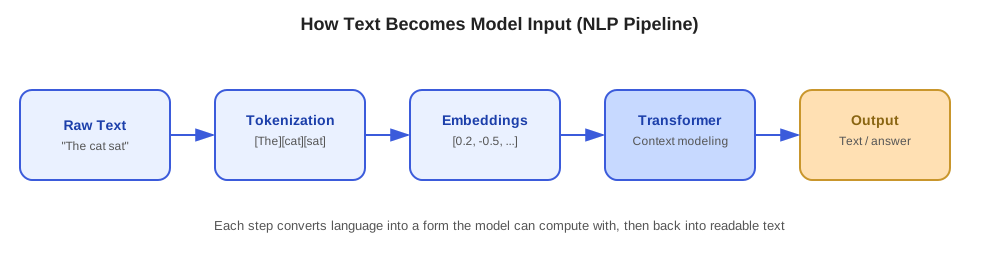
- Tokenization — Breaking text into smaller units called tokens (which can be words, parts of words, or characters).
- Embeddings — Converting tokens into numerical vectors that capture their meaning, so that words with similar meanings end up with similar numerical representations.
- Context modeling — Using the surrounding words in a sentence (context) to understand meaning more precisely, since the same word can mean different things depending on context (e.g., "bank" of a river vs. a "bank" account).
Large Language Models (LLMs)
- LLMs are a type of deep learning model, built on the Transformer architecture, trained on massive amounts of text data.
- They learn statistical relationships between words and phrases, allowing them to predict likely next words, generate coherent text, answer questions, summarize content, and more.
- Tools like Gemini are powered by LLMs, which is why they can handle such a wide range of language-based tasks with a single model.
- LLMs generate output by predicting the most probable next token based on patterns learned during training — they aren't "looking up" answers from a database, they're generating a statistically likely response.
Why prompting matters in NLP tools
- The way a request (prompt) is phrased directly affects the quality and relevance of an NLP model's output.
- Being specific about tone, format, audience, and desired length helps the model produce output closer to what's actually needed.
- Reviewing and refining prompts iteratively is often necessary to get a final, usable result — this is sometimes called "prompt engineering."
Common challenges in NLP
- Ambiguity — Human language is often ambiguous, sarcastic, or context-dependent, which can be difficult for models to interpret correctly.
- Bias in language data — Since NLP models learn from large volumes of human-written text, they can pick up and reproduce societal biases present in that data.
- Hallucination — Language models can generate text that sounds fluent and confident but is factually incorrect, since they are generating statistically likely text rather than verifying facts.
- Multilingual and cultural nuance — Language, idioms, and meaning vary significantly across languages and cultures, which can be challenging for models to handle equally well across all of them.
Why this matters in practice
Understanding NLP basics helps in recognizing:
- Why AI writing and chat tools can sound so natural — they're built on models trained specifically to understand and generate human language.
- Why the same prompt can produce different quality results depending on how it's worded.
- Why AI-generated text should always be reviewed for factual accuracy, since fluent-sounding text isn't always correct.
- How everyday tools like translation apps, chatbots, and email assistants all trace back to the same underlying NLP techniques.