Back to Express JS Course
Express JS Course
In the context of Express JS, routers are used to organize routes in a modular way. This helps to keep your application clean and maintainable, especially as it grows larger.
Lets refactor our code to include routers.
validationSchemas.mjs
export const createUserValidationSchema = {
    name: {
        isLength: {
            options: {
                min: 5,
                max: 32,
            },
            errorMessage:
                "name must be at least 5 characters with a max of 32 characters",
        },
        notEmpty: {
            errorMessage: "name cannot be empty",
        },
        isString: {
            errorMessage: "name must be a string!",
        },
    },
    designation: {
        notEmpty: true,
    },
    city: {
        notEmpty: true,
    },
};
userRouter.mjs
import express from 'express';
import { checkSchema, validationResult } from 'express-validator';
import { createUserValidationSchema } from '../utils/validationSchemas.mjs';

const router = express.Router();

const mockUsers = [
    { id: 1, name: 'Praveen', designation: 'Technical Architect', city: 'Hyderabad' },
    { id: 2, name: 'Prasad', designation: 'Technical Lead', city: 'Bangalore' },
    { id: 3, name: 'Anusha', designation: 'Lead Developer', city: 'Chennai' },
    { id: 4, name: 'Ravi', designation: 'Developer', city: 'Hyderabad' },
    { id: 5, name: 'Kiran', designation: 'Technical Lead', city: 'Hyderabad' },
];

// Middleware for authentication
const authenticate = (req, res, next) => {
    const apiKey = req.headers['x-api-key'];
    if (apiKey && apiKey === '2a5699ae-6e99-4cac-ae55-bb769d9e6090') {
        next();
    } else {
        res.status(401).send('Unauthorized');
    }
};

// Route to get all users
router.get('/', authenticate, (req, res) => {
    let filteredUsers = mockUsers;

    const { name, designation, city } = req.query;

    if (name) {
        filteredUsers = filteredUsers.filter(user => user.name.toLowerCase().includes(name.toLowerCase()));
    }

    if (designation) {
        filteredUsers = filteredUsers.filter(user => user.designation.toLowerCase().includes(designation.toLowerCase()));
    }

    if (city) {
        filteredUsers = filteredUsers.filter(user => user.city.toLowerCase().includes(city.toLowerCase()));
    }

    res.send({ users: filteredUsers });
});

// Route to get a single user by ID
router.get('/:id', (req, res) => {
    const parsedId = parseInt(req.params.id);
    if (isNaN(parsedId)) res.status(400).send({ msg: "Bad Request. Invalid ID" });
    const findUser = mockUsers.find((user) => user.id === parsedId);
    if (!findUser) res.status(404).send({ msg: "ID Not Found" });
    res.send(findUser);
});

// Route to add a new user
router.post('/', checkSchema(createUserValidationSchema), (req, res) => {
    const errors = validationResult(req);
    if (!errors.isEmpty()) {
        return res.status(400).json({ errors: errors.array() });
    }

    const newUser = req.body;

    // Validate the incoming data
    if (!newUser.name || !newUser.designation || !newUser.city) {
        return res.status(400).send({ msg: 'Bad Request. Missing required fields' });
    }

    // Assign a new ID to the new user
    newUser.id = mockUsers.length ? mockUsers[mockUsers.length - 1].id + 1 : 1;

    // Add the new user to the mockUsers array
    mockUsers.push(newUser);

    // Respond with the newly created user
    res.status(201).send({ user: newUser });
});

// Route to update an existing user
router.put('/:id', (req, res) => {
    const parsedId = parseInt(req.params.id, 10);
    if (isNaN(parsedId)) {
        return res.status(400).send({ msg: 'Bad Request. Invalid ID' });
    }

    const findUser = mockUsers.find((user) => user.id === parsedId);
    if (!findUser) {
        return res.status(404).send({ msg: 'ID Not Found' });
    }

    const { name, designation, city } = req.body;
    if (!name || !designation || !city) {
        return res.status(400).send({ msg: 'Bad Request. Missing required fields' });
    }

    // Update user data
    findUser.name = name;
    findUser.designation = designation;
    findUser.city = city;

    res.send({ user: findUser });
});

// PATCH endpoint to update user by ID
router.patch('/:id', (req, res) => {
    const id = parseInt(req.params.id);
    const updatedUser = req.body;

    // Find the user by ID
    const userToUpdate = mockUsers.find(user => user.id === id);

    // If the user is found, update its properties
    if (userToUpdate) {
        userToUpdate.name = updatedUser.name;
        userToUpdate.designation = updatedUser.designation;
        userToUpdate.city = updatedUser.city;
        res.status(200).json({ message: 'User updated successfully', user: userToUpdate });
    } else {
        res.status(404).json({ message: 'User not found' });
    }
});

// Route to delete a user
router.delete('/:id', (req, res) => {
    const userId = parseInt(req.params.id);
    const userIndex = mockUsers.findIndex(user => user.id === userId);
    if (userIndex !== -1) {
        mockUsers.splice(userIndex, 1);
        res.status(204).send(); // No Content
    } else {
        res.status(404).send('User not found');
    }
});

export default router;
index.mjs
import express from 'express';
import usersRouter from './routes/usersRouter.mjs';

const app = express();
const PORT = process.env.PORT || 5000;

// Middleware to parse JSON bodies
app.use(express.json());

// Middleware to log requests
app.use((req, res, next) => {
    console.log(`${new Date().toISOString()} - ${req.method} ${req.url}`);
    next();
});

// Route for the home page
app.get('/', (req, res) => res.send({ msg: "Welcome To Praveen Oruganti!" }));

// Mounting the usersRouter for all routes starting with /api/v1_0/users
app.use('/api/v1_0/users', usersRouter);

// Start the server
app.listen(PORT, () => console.log(`Running on Port ${PORT}`));
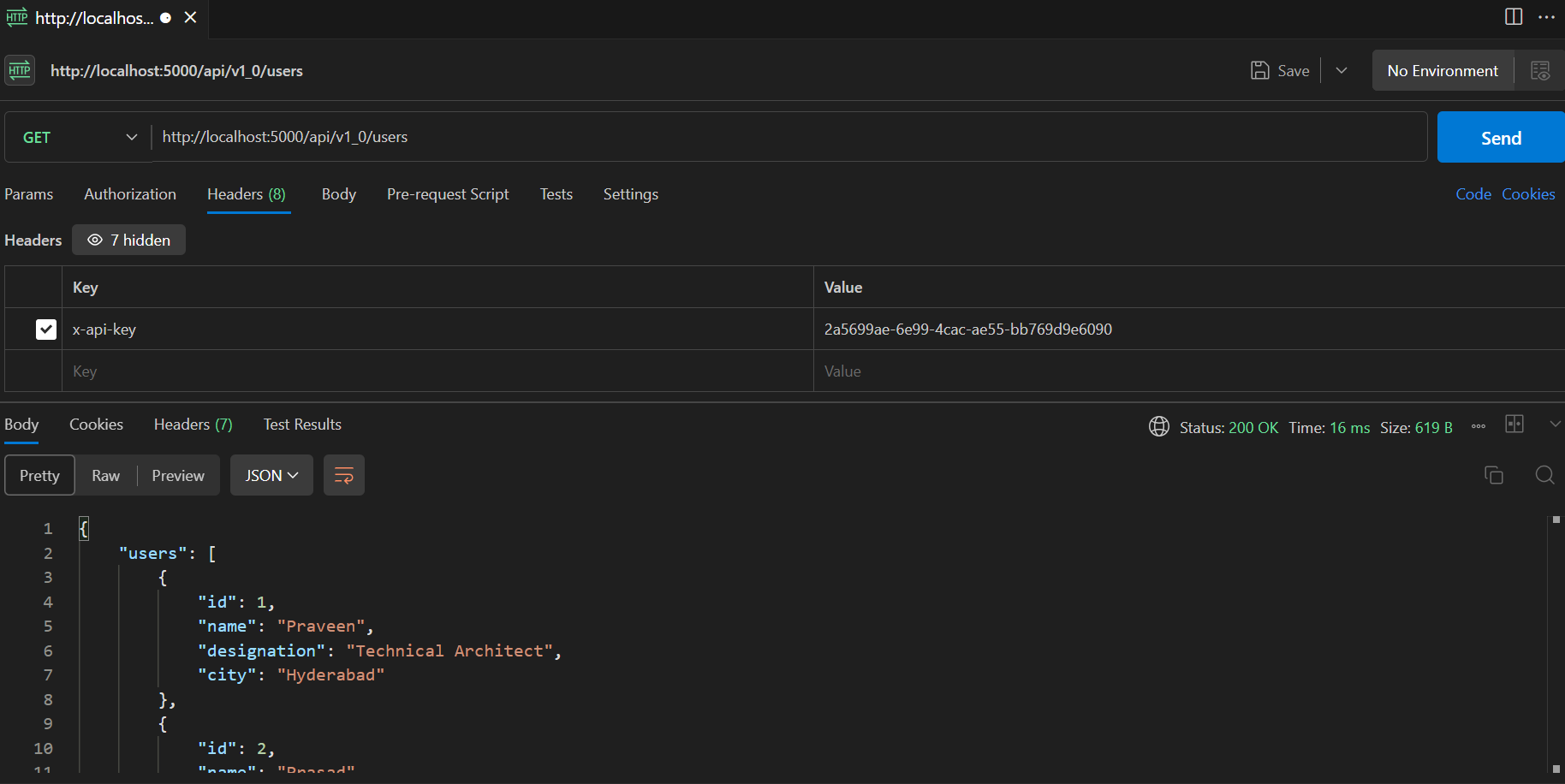
Lets invoke get all users endpoint