Java Course
In Java, variables come in three distinct types: local variables, instance variables, and static variables.
Local Variables:
-
Defined within a specific method or code block
-
Only accessible within that method/block
-
Cease to exist when the method/block completes
Instance Variables:
-
Belong to a specific object or instance of a class
-
Can be accessed throughout the entire class
-
Persist as long as the object exists
Static Variables:
-
Belong to the class itself, not any specific object
-
Can be accessed without creating an instance of the class
-
Shared across all objects of that class
-
Often used for constants or class-level data
Static vs Non Static
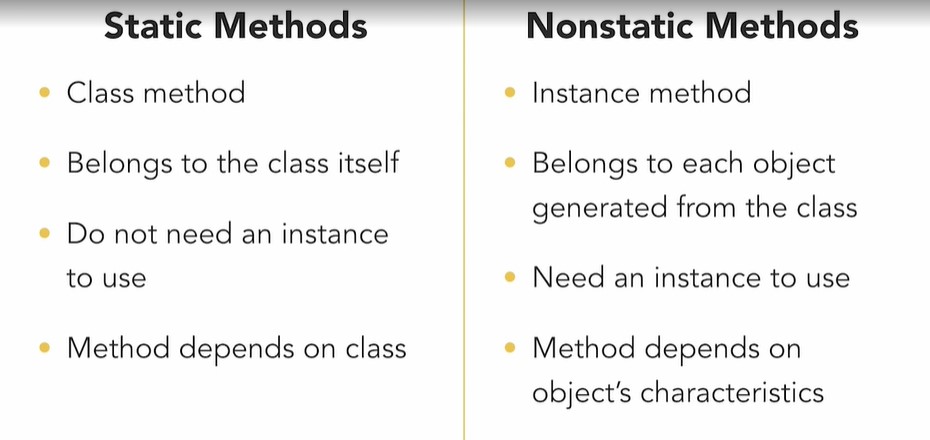
Now Lets see about Control Flow, there are two types of Control Flow.
-
Static Control Flow
-
Identification of static members from top to bottom.
-
Execution of static variable assignments and static blocks from top to bottom.
-
Execution of main method.
-
-
Instance Control Flow
-
Identification of instance members from top to bottom.
-
Execution of instance variable assignments and instance blocks from top to bottom.
-
Execution of constructor.
-
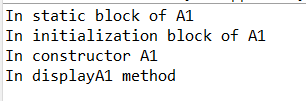
Let's see sample code
public class ControlFlow {
   public static void main(String args[]) {
      A1 a1 = new A1();
      a1.displayA1();
   }
}
class A1 {
   A1() {
      System.out.println("In constructor A1");
   }
   static {
      System.out.println("In static block of A1");
   }
   {
      System.out.println("In initialization block of A1");
   }
   void displayA1() {
      System.out.println("In displayA1 method");
   }
}
Output