Kubernetes Course
Why Externalize Configuration?
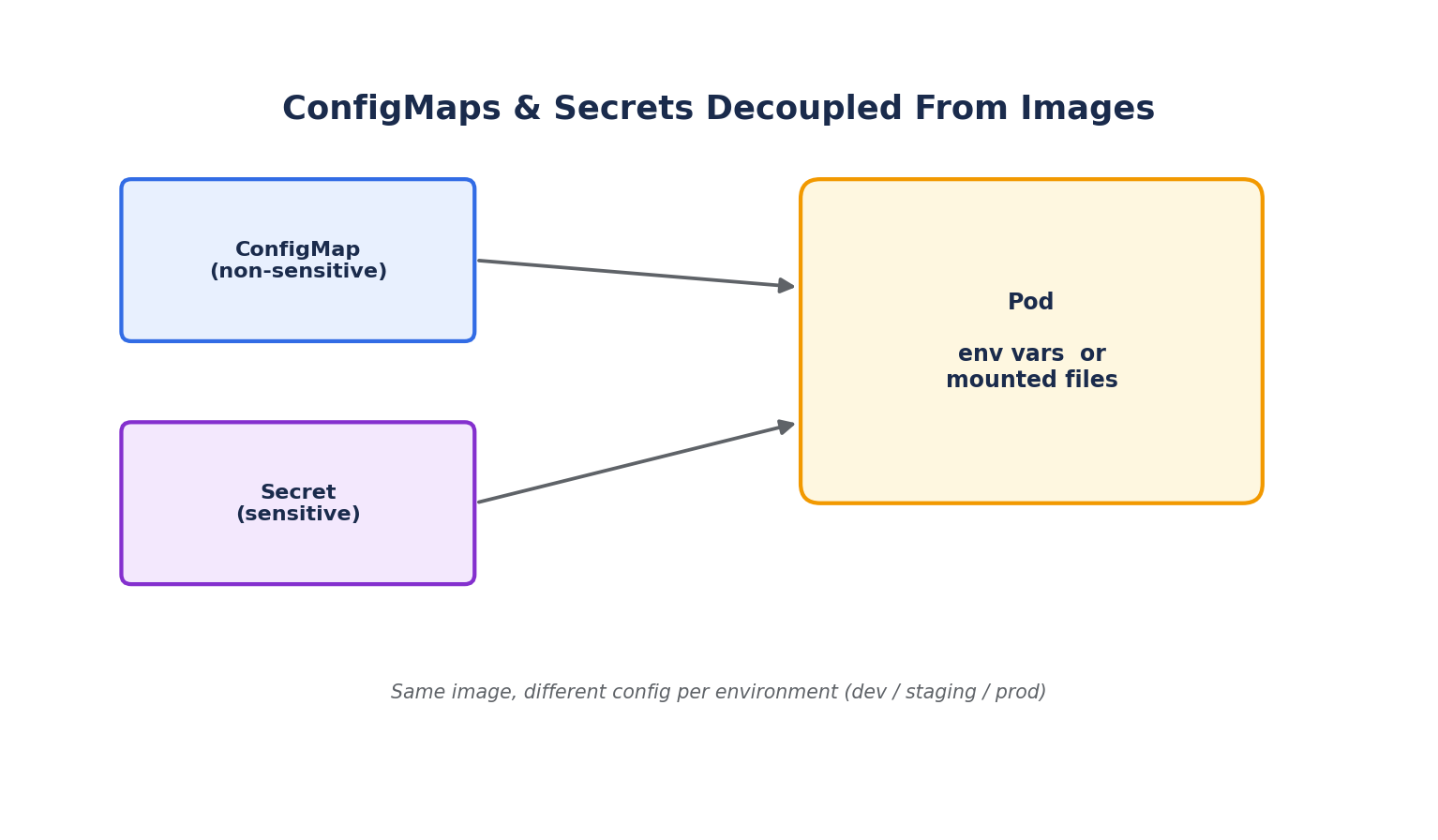
Container images should be environment-agnostic — the same image that runs in dev should run unchanged in production, with only the configuration differing. Baking environment-specific values (database URLs, feature flags, credentials) into the image means rebuilding it for every environment, which defeats the purpose of containerization. Kubernetes solves this with two objects: ConfigMaps for non-sensitive data, and Secrets for sensitive data.
ConfigMaps
A ConfigMap stores non-confidential key-value configuration data as a separate cluster object, decoupled from the Pod spec and the image.
apiVersion: v1
kind: ConfigMap
metadata:
  name: app-config
data:
  APP_ENV: "production"
  LOG_LEVEL: "info"
  application.properties: |
    server.port=8080
    feature.new-checkout=true
kubectl create configmap app-config --from-literal=APP_ENV=production
kubectl create configmap app-config --from-file=application.properties
kubectl get configmap app-config -o yaml
Consuming a ConfigMap as environment variables:
spec:
  containers:
    - name: app
      image: myapp:1.0
      envFrom:
        - configMapRef:
            name: app-config
Consuming a ConfigMap as a mounted file (useful for full config files, not just key-value pairs):
spec:
  containers:
    - name: app
      image: myapp:1.0
      volumeMounts:
        - name: config-volume
          mountPath: /etc/config
  volumes:
    - name: config-volume
      configMap:
        name: app-config
With a mounted ConfigMap, each key becomes a file inside /etc/config, and the file's contents are the corresponding value — well suited for mounting an entire application.properties or nginx.conf file into a container unchanged.
Secrets
A Secret is structurally almost identical to a ConfigMap, but intended for sensitive values — passwords, tokens, TLS certificates, SSH keys.
apiVersion: v1
kind: Secret
metadata:
  name: db-credentials
type: Opaque
data:
  username: YWRtaW4=       # base64-encoded "admin"
  password: cGFzc3dvcmQxMjM=  # base64-encoded "password123"
kubectl create secret generic db-credentials \
  --from-literal=username=admin \
  --from-literal=password=password123
spec:
  containers:
    - name: app
      image: myapp:1.0
      env:
        - name: DB_USERNAME
          valueFrom:
            secretKeyRef:
              name: db-credentials
              key: username
        - name: DB_PASSWORD
          valueFrom:
            secretKeyRef:
              name: db-credentials
              key: password
Important — Secrets are base64-encoded, not encrypted, by default. Anyone with API access to read the Secret object (or etcd directly) can trivially decode it. Base64 is an encoding, not encryption — it exists so arbitrary binary data (like a certificate) can be safely represented as text in YAML.
- To actually protect Secrets at rest, enable encryption at rest for etcd (an
EncryptionConfigurationon the API server). - For production-grade secret management, most teams use external tools rather than raw Kubernetes Secrets: HashiCorp Vault, AWS Secrets Manager (via the External Secrets Operator), or cloud-native KMS integrations.
- Restrict who can read Secret objects using RBAC (covered in a later lesson) —
get/listonsecretsshould be tightly scoped.
Secret Types
| Type | Purpose |
|---|---|
| Opaque | Arbitrary user-defined key-value data (the default) |
| kubernetes.io/tls | TLS certificate and private key, used by Ingress for HTTPS |
| kubernetes.io/dockerconfigjson | Credentials for pulling images from a private container registry |
| kubernetes.io/service-account-token | Automatically generated tokens for ServiceAccount authentication |
kubectl create secret tls tls-secret --cert=tls.crt --key=tls.key
kubectl create secret docker-registry regcred \
  --docker-server=myregistry.io \
  --docker-username=myuser \
  --docker-password=mypass
Live Updates and Reloading
When a ConfigMap or Secret mounted as a volume is updated, the file contents inside the Pod are updated automatically (usually within a minute), without restarting the Pod. However, most applications don't watch their config files for changes and won't pick up the new values until restarted — so many teams pair config updates with a rolling restart (kubectl rollout restart deployment/<name>) to guarantee the new configuration takes effect. Environment variables sourced from a ConfigMap/Secret, in contrast, are never updated live — changing them always requires a Pod restart.