Kubernetes Course
Why Deployments Aren't Enough for Stateful Apps
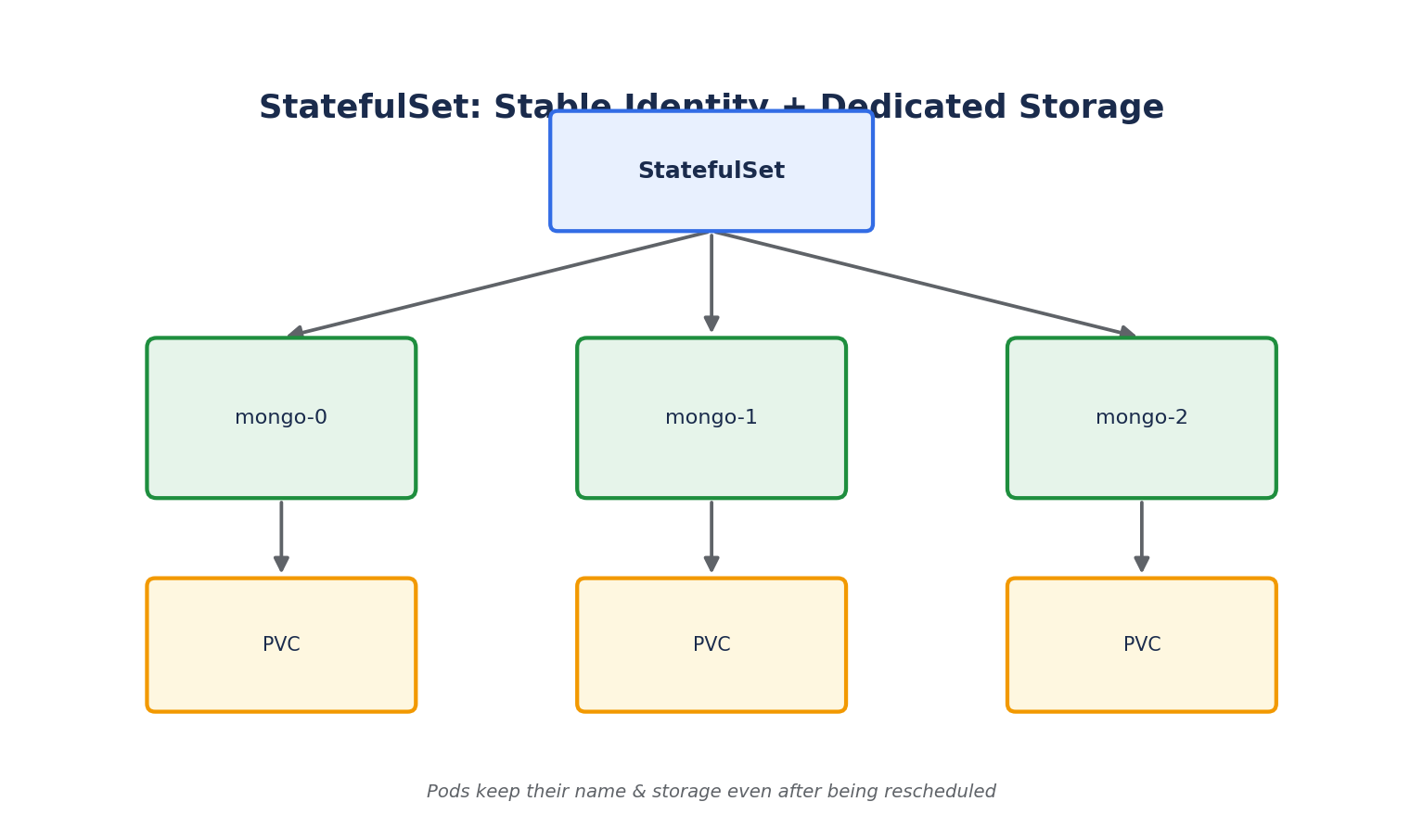
A Deployment treats its Pods as interchangeable — any replica can be scaled up, down, or replaced, with a randomly generated name and no guaranteed identity. This is perfect for stateless apps, but breaks down for applications like databases and message queues that need:
- A stable, predictable network identity for each replica (e.g.,
mongo-0should always bemongo-0, not a new random name after every restart). - Stable, dedicated storage per replica, that follows that specific replica even if it's rescheduled to a different node.
- Ordered, sequential startup and shutdown (e.g., a database primary must be up before replicas join).
StatefulSet is the controller designed for exactly these requirements.
StatefulSet Example
apiVersion: apps/v1
kind: StatefulSet
metadata:
  name: mongo
spec:
  serviceName: mongo-headless
  replicas: 3
  selector:
    matchLabels:
      app: mongo
  template:
    metadata:
      labels:
        app: mongo
    spec:
      containers:
        - name: mongo
          image: mongo:7.0
          ports:
            - containerPort: 27017
          volumeMounts:
            - name: mongo-data
              mountPath: /data/db
  volumeClaimTemplates:
    - metadata:
        name: mongo-data
      spec:
        accessModes: ["ReadWriteOnce"]
        resources:
          requests:
            storage: 10Gi
volumeClaimTemplatesis the key difference from a Deployment: instead of every replica sharing one PVC, Kubernetes creates a separate PVC for each replica (mongo-data-mongo-0,mongo-data-mongo-1,mongo-data-mongo-2), and that PVC follows its Pod even across rescheduling.- Pods get predictable, stable names:
mongo-0,mongo-1,mongo-2— never randomly suffixed like a Deployment's Pods. - Pods are created and scaled in order (
mongo-0beforemongo-1beforemongo-2) and terminated in reverse order by default — important for clustered databases with leader/follower semantics.
Headless Services
StatefulSets are almost always paired with a headless Service (clusterIP: None), which doesn't load-balance — instead, DNS lookups return the individual IPs of every matching Pod, so each replica can be addressed directly:
apiVersion: v1
kind: Service
metadata:
  name: mongo-headless
spec:
  clusterIP: None
  selector:
    app: mongo
  ports:
    - port: 27017
Each Pod also gets its own stable DNS name: mongo-0.mongo-headless.default.svc.cluster.local — essential for clustered databases where nodes need to address each other individually, not through a single load-balanced endpoint.
kubectl get statefulset
kubectl get pods -l app=mongo -w    # Watch ordered creation
kubectl scale statefulset mongo --replicas=5
DaemonSets
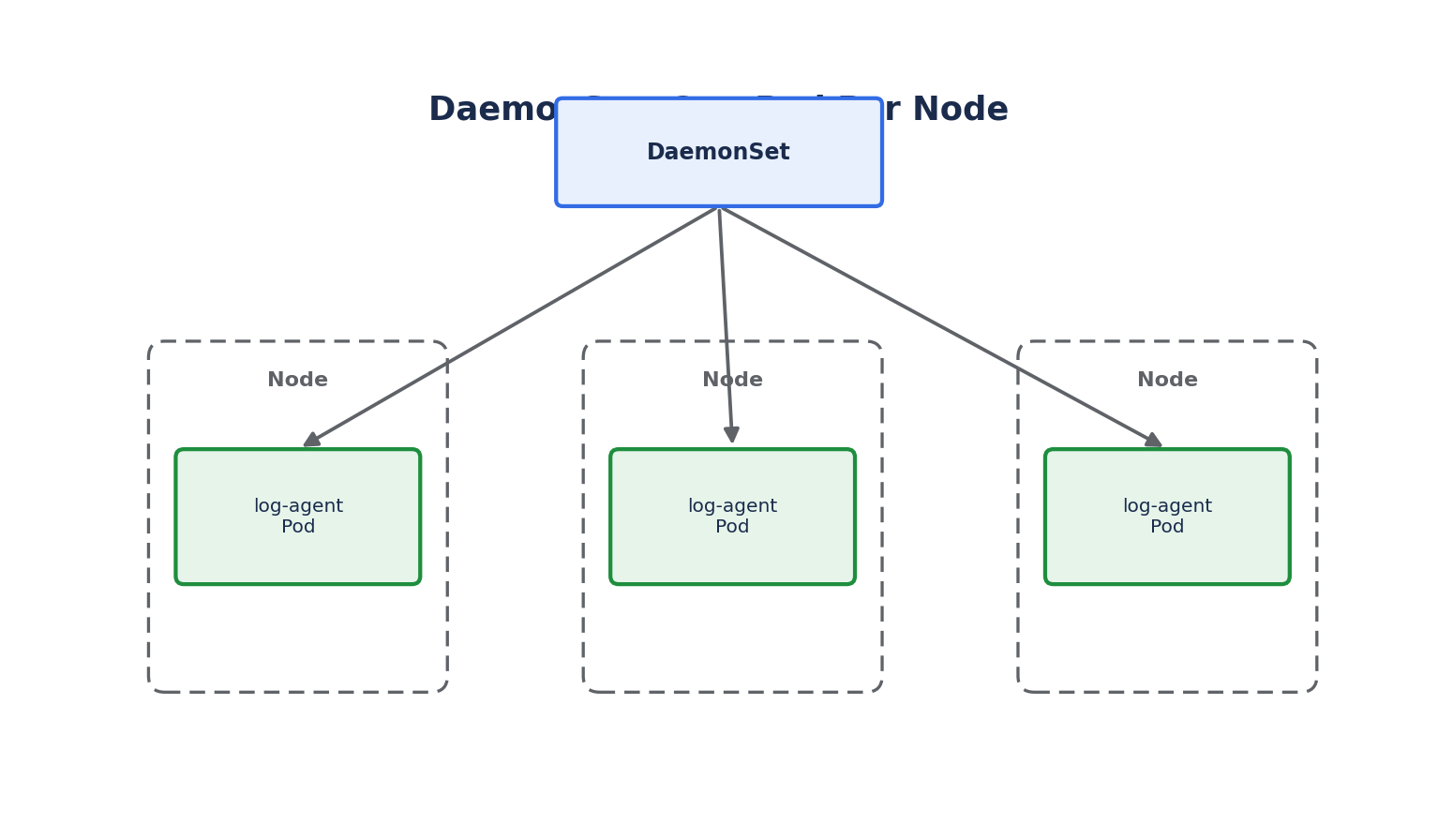
A DaemonSet ensures that exactly one copy of a Pod runs on every node (or a chosen subset of nodes) — the opposite goal from a Deployment, which doesn't care which nodes Pods land on, just how many total replicas exist.
Common DaemonSet use cases:
- Log collection agents (e.g., Fluentd, Filebeat) that need to run on every node to collect logs from all Pods there.
- Monitoring agents (e.g., Prometheus Node Exporter, Datadog Agent) that report node-level metrics.
- Network plugins (many CNI implementations run as a DaemonSet themselves).
- Storage daemons that need direct access to node-local disks.
apiVersion: apps/v1
kind: DaemonSet
metadata:
  name: node-exporter
spec:
  selector:
    matchLabels:
      app: node-exporter
  template:
    metadata:
      labels:
        app: node-exporter
    spec:
      containers:
        - name: node-exporter
          image: prom/node-exporter:latest
          ports:
            - containerPort: 9100
- No
replicasfield — a DaemonSet's replica count is implicitly "one per matching node." - As new nodes join the cluster, the DaemonSet automatically schedules a Pod onto them; as nodes are removed, their Pods are garbage collected.
spec.template.spec.nodeSelectororaffinityrules can restrict a DaemonSet to a subset of nodes (e.g., only GPU nodes).
kubectl get daemonset -A
kubectl rollout status daemonset/node-exporter