React JS Course
Redux is a tool to help you manage global state. Redux is built around the concept of actions and reducers.
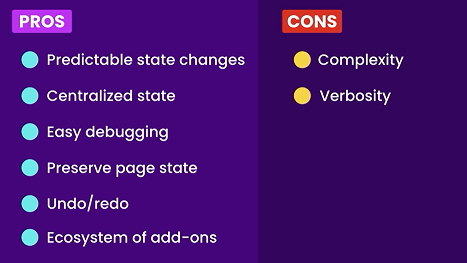
The advantages of Redux are
- Centralizes application's state
- Makes data flow transparent and predictable
Redux Architecture
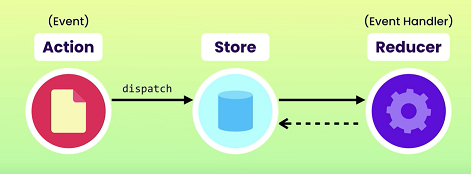
We need to follow the below steps in building a redux app.
- Design the store
- Define the actions
- Create a reducer
- Setup the store
- Action
Actions are just objects with a type and a payload(optional). Each action has a case correlated in the reducer file. Actions only tell what to do, but they don't tell how to do.
For example,
return {
type: ADD_EMPLOYEE,
payload: employee
}
Action Creator
Pure function which creates an action
For example,
const addEmployee = employee => {
return {
type: ADD_EMPLOYEE,
payload: employee
}
}
This is Reusable, Portable and Easy To Test.
- Reducer
Reducers are the functions that take the current state and an action as arguments, and return a new state result.
For example,
const intialState = {
employees: [],
}

const reducer = (state = intialState, action) => {
switch (action.type) {
case FETCH_EMPLOYEES:
return {
employees: action.payload,
}
case ADD_EMPLOYEE:
return {
...state,
employees: [...state.employees, action.payload],
}
case DELETE_EMPLOYEE:
return {
employees: [
...state.employees.filter(employee => employee !== action.payload)
]
}
case UPDATE_EMPLOYEE:
return {
employees: [

                    ...state.employees.map(emp =>
                        emp.emailId === action.payload.emailId ?
                            { ...state.employees, ...action.payload } : emp)
                ]
            }


        default: return state
    }

}
- Store
The Redux store brings together the state, actions and reducers that make up your app.
It's important to note that you will only have a single store in a Redux application.
Every Redux store has a single root reducer function.
For example,
const rootReducer = combineReducers({
employee: employeeReducer
})

import { createStore, applyMiddleware } from 'redux';
import thunk from 'redux-thunk';
const store = createStore(rootReducer, applyMiddleware(thunk))
In redux, you need to dispatch your action. You can perform logic and asynchronous calls here. After your action is dispatched, redux will look for a case in reducer that matches the type. The reduceris where state update happen. Combine all this together and you will have powerful global state management.
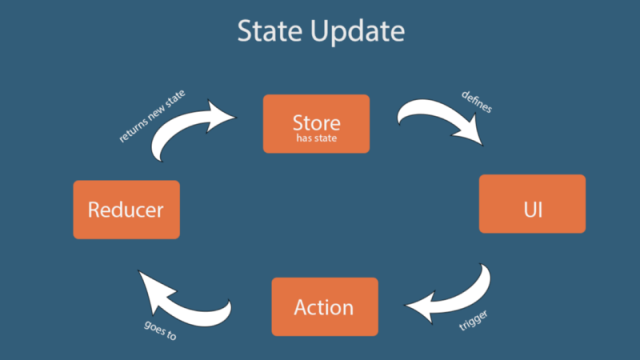
Redux Principles
- Single source of Truth
The global state of your application is stored as an object inside a single store.
- State is Read-Only
The only way to change the state is to dispatch an action.
-
Immutability, One-way data flow, Predictability of outcome
-
Changes are Made with Pure Reducer Functions