Spring Boot Course
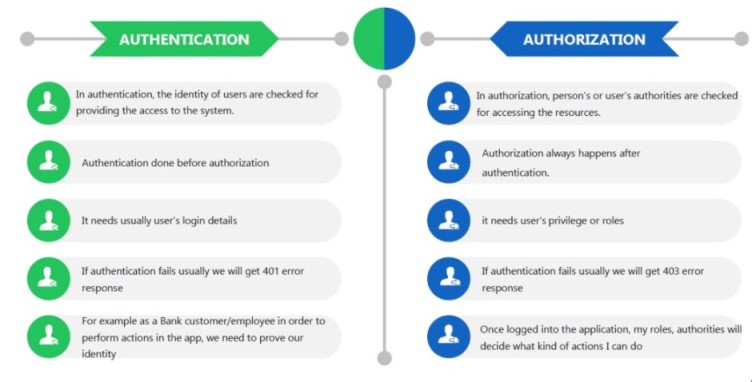
What are authentication and authorization? Which must come first?
Authentication
- Determination of who
- Technically it is the determination if a principal is who they say they are
- Principals can be human or machines
In Spring Security, the authentication process consists of the following steps quoted from the Spring Security reference:
- The username and password are obtained and combined into an instance of UsernamePasswordAuthenticationToken (an instance of the Authentication interface).
- The token is passed to an instance of AuthenticationManager for validation.
- The AuthenticationManager returns a fully populated Authentication instance on successful authentication.
- The security context is established by calling SecurityContextHolder.getContext() .setAuthentication(…), passing in the returned authentication object.
Authorization
- Determines what the principal can or cannot do
- Authorization is based on authentication
- Authorization is often called as access control
Authorization typically involves the following two separate aspects that combine to describe the accessibility of the secured system:
- The first is the mapping of an authenticated principal to one or more authorities (often called roles);
- The second is the assignment of authority checks to secured resources of the system.
Which must come first?
Unless there is some type of authorization that specifies what resources and/or functions that can be accessed by anonymous users, authentication must always come before authorization.
Application Security Framework
- Login and Logout Functionality
- Allow/block access to URLs to logged in users
- Allow/block access to URLs to logged in users and with certain roles
Handles common vulnerabilities
- Session fixation
- Clickjacking
- Cross-site request forgery (CSRF)
With Spring Security we can do
- Username/password Authentication
- SSO/Okta/LDAP
- App Level Authorization
- Intra App Authorization like OAuth
- Microservice security(using tokens,JWT)
- Method Level Security
5 Core concepts in Spring Security
-
Authentication(Who is this User?)
Establishing that a principal's credentials are valid.
-
Authorization(Are they allowed to do this?)
Deciding if a principal is allowed to perform an action. Authentication comes first before Authorization because authorization process needs principal object with authority votes to decide user allow to perform a action for secured resource.
-
Principal (currently logged in user(per request) and each user have multiple ID's)
The principal is the currently logged in user.
-
Granted Authority(fine grain permissions of what user can do)
GrantedAuthority as an individual privilege for example could include READ_AUTHORITY, WRITE_PRIVILEGE, or even CAN_EXECUTE_AS_ROOT. When using a GrantedAuthority directly, such as through the use of an expression like
hasAuthority('READ_AUTHORITY'), we are restricting access in a fine-grained manner. -
Roles(group of authorities that can be assigned to a user i.e.. coarse grained permissions(i.e.. grouping of permissions ))
We can think of each Role as a coarse-grained GrantedAuthority that is represented as a String and prefixed with "ROLE". When using a Role directly, such as through an expression like hasRole("ADMIN"), we are restricting access in a coarse-grained manner.
Spring Security Flow
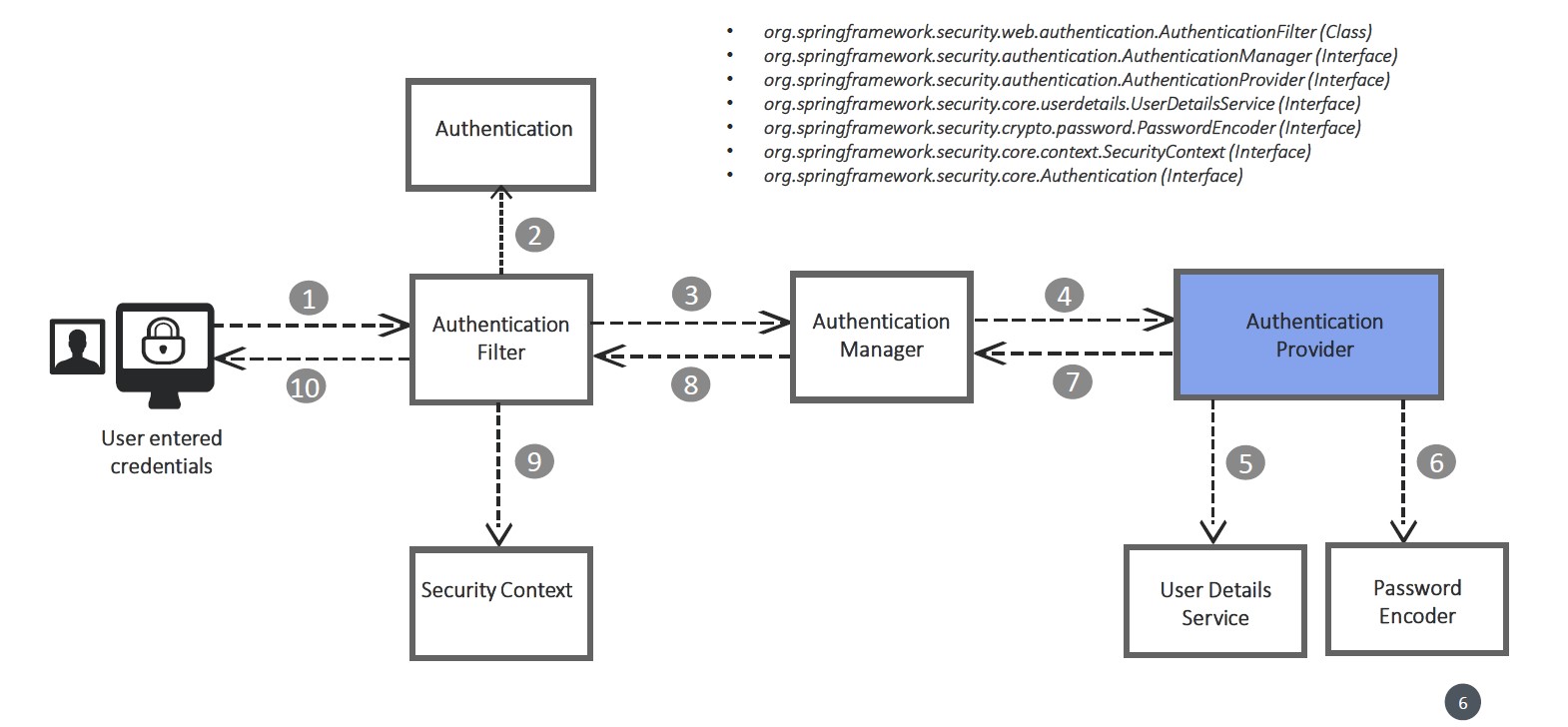
- AuthenticationFilter : A filter that intercepts and performs authentication of a particular request by delegating it to the authentication manager If authentication is successful, the authentication details is set into SecurityContext.
- Authentication : Using the supplied values from the user like username and password, the authentication object will be formed which will be given as an input to the AuthenticationManager interface.
- AuthenticationManager : Once received request from filter it delegates the validating of the user details to the authentication provider.
- AuthenticationProvider : It has all the logic of validating user details using UserDetailsService and PasswordEncoder.
- UserDetailsService : UserDetailsService retrieves UserDetails and implements the User interface using the supplied username.
- PasswordEncoder : Service interface for encoding passwords.
- SecurityContext : Interface defining the minimum security information associated with the current thread of execution It holds the authentication data post successful authentication.
User Management
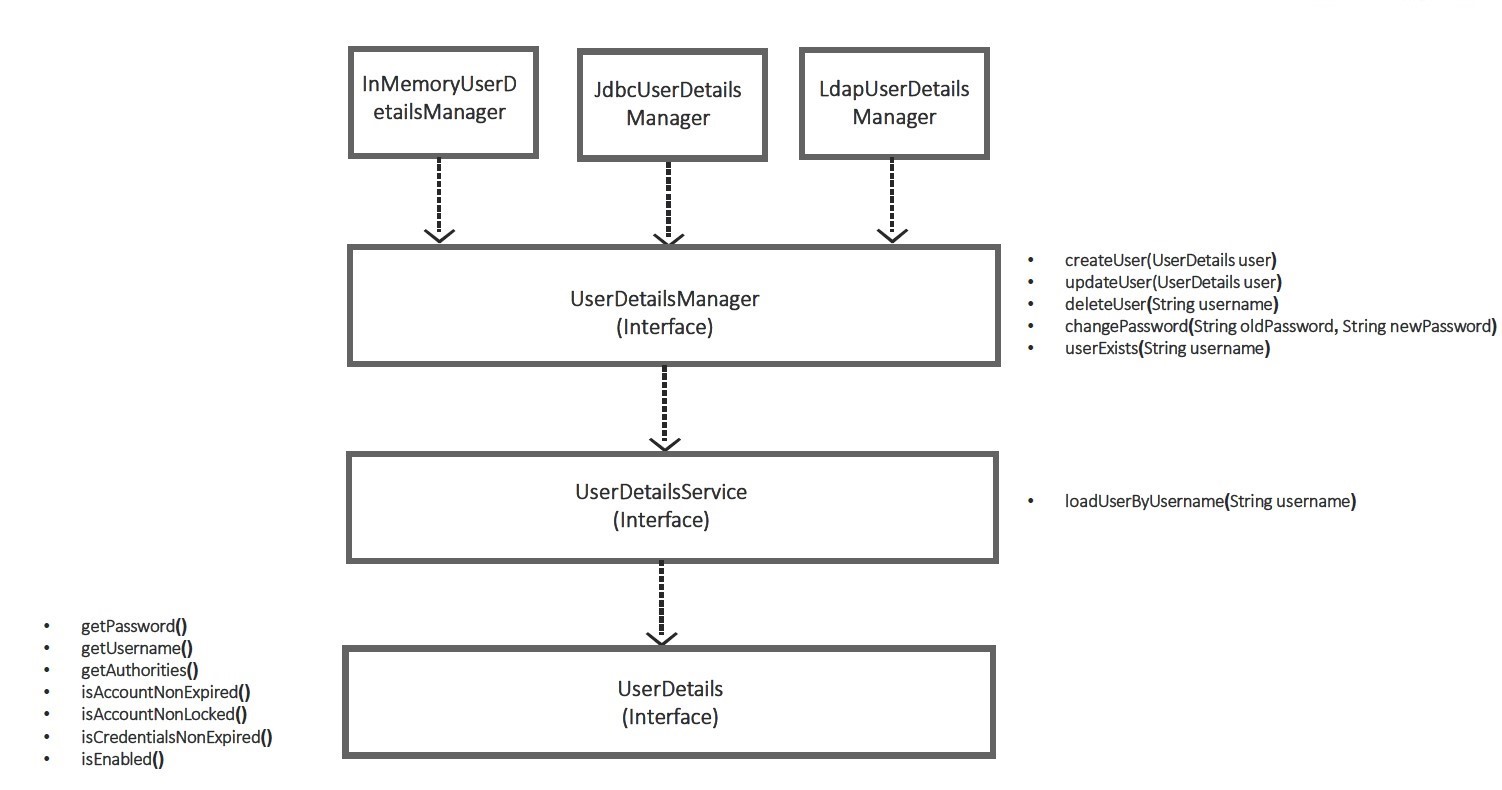
org.springframework.security.core.userdetails.UserDetails
org.springframework.security.core.userdetails.User
org.springframework.security.core.userdetails.UserDetailsService
org.springframework.security.provisioning.UserDetailsManager
org.springframework.security.provisioning.InMemoryUserDetailsManager
org.springframework.security.provisioning.JdbcUserDetailsManager
org.springframework.security.ldap.userdetails.LdapUserDetailsManager
Let's explore different types of authentication and authorization in Spring Boot Security, using the Employee Management Service that we created in the previous session:
- Form-Based Authentication
- Basic Authentication
- In-Memory Authentication
- JDBC Authentication
- JWT Authentication
- OAuth