System Design Course
Here with the various Architecture Styles
API ArchitectureSolution ArchitectureInfrastructure ArchitectureSystem ArchitectureData ArchitectureUI Architecture
API Architecture
API Architecture refers to the design and structure of Application Programming Interfaces (APIs) which allow different software systems to communicate with each other. It focuses on how APIs are created, managed, and utilized within an ecosystem.
Key Concepts
RESTful APIs:Utilize HTTP requests to GET, PUT, POST, and DELETE data.SOAP APIs:Protocol for exchanging structured information in web services using XML.GraphQL:Query language for APIs and a runtime for executing those queries.API Gateway:Manages and secures API traffic.Rate Limiting:Controls the number of API calls a client can make.
Best Practices
- Ensure security through authentication and authorization (e.g., OAuth).
- Use versioning to handle updates without breaking existing clients.
- Design for scalability and performance.
There are two approaches to design API's.
-
Top-down API Development:driven by business and IT stakeholders with a service or capability requirement approach. -
Bottom-up API and Service development:focusing on developers building APIs in an environment that maximizes their efficiency and enables transparency into their work.
API Design Principles
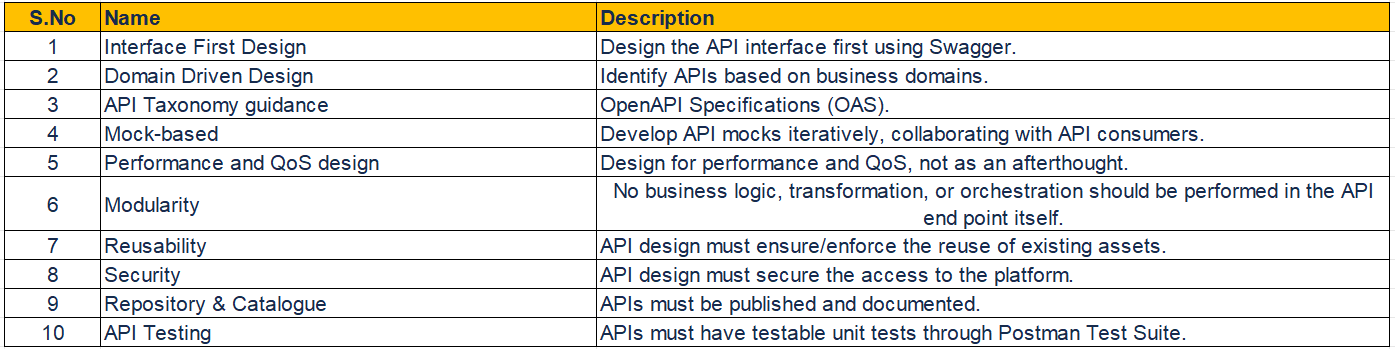
APIs should follow OpenAPI Specification(OAS).
Below are the API best practices we would be following during design & development phase.
Types of APIs
-
Experience APIs:These APIs are tailored to enhance the user experience on different consumer platforms such as web and mobile devices. They are designed to minimize the number of calls needed to perform a function, streamlining interactions by aggregating data and functions into single, cohesive responses. -
Business APIs:These APIs encapsulate core business logic and capabilities, facilitating reusable services across various parts of the application. They act as the backbone for business processes, ensuring consistent business rule application and data manipulation. -
Composite APIs:These APIs combine multiple tasks or requests into single calls to simplify client interactions with backend systems. This reduces the load and complexity on the client side and improves the efficiency of data processing. -
Utility APIs:Utility APIs provide commonly used services across the application, such as logging, notification services, and configuration management. They are designed to support the functionality of other APIs by providing general utilities that do not include business logic. -
Domain APIs:These APIs are closely aligned with business domain models and are responsible for handling detailed, domain-specific tasks. They provide a more granular level of functionality and data access, typically used by business and composite APIs. -
Inbound APIs:Inbound APIs are interfaces through which external systems or services can send data to the platform. They are crucial for receiving data, initiating processes, or triggering responses based on external requests. -
Outbound APIs:Outbound APIs enable the platform to send data or requests to external systems. These are vital for integrating with external services, pushing notifications, or executing actions outside the internal ecosystem.
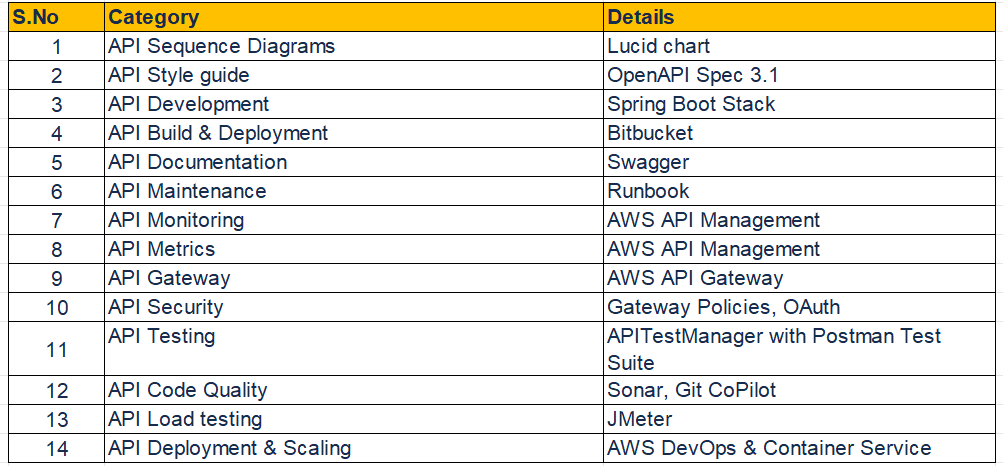
API Development Tools
Below are the development tools used to manage API Lifecycle.
Solution Architecture
Solution Architecture is the process of designing a comprehensive solution to meet a specific business need. It involves integrating different technologies and systems to solve business problems.
Key Concepts
Requirements Gathering:Understanding business needs and constraints.Technology Selection:Choosing appropriate tools, platforms, and frameworks.Integration:Ensuring various components work together seamlessly.Non-Functional Requirements:Addressing scalability, reliability, security, and performance.
Best Practices
- Align solutions with business objectives.
- Ensure clear documentation and communication.
- Use a modular approach to allow for flexibility and scalability.
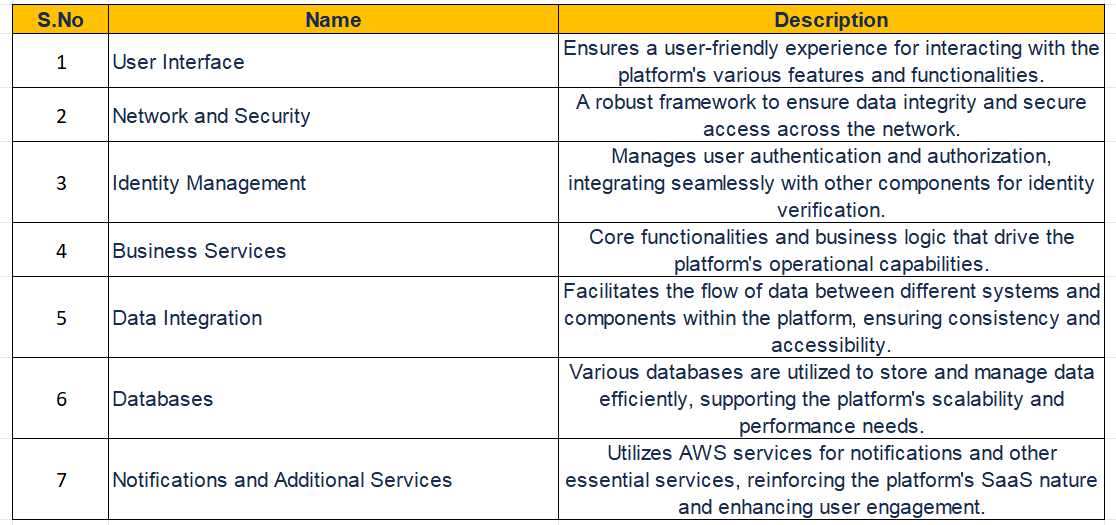
Components of Solution Architecture are
Infrastructure Architecture
Infrastructure Architecture focuses on the physical and virtual resources required to support the operation of applications and services. It includes servers, storage, networking, and other foundational elements.
Key Concepts
Data Centers:Facilities that house computing resources.Cloud Computing:Utilizing remote servers hosted on the internet to store, manage, and process data (e.g., AWS, Azure).Networking:Design and management of networks to ensure connectivity and communication.Virtualization:Creating virtual instances of physical resources.
Best Practices
- Implement redundancy and failover mechanisms.
- Ensure security through firewalls, encryption, and access controls.
- Plan for scalability to handle growth and changes in demand.
System Architecture
System Architecture encompasses the overall design and structure of a system, including its components and their interactions. It provides a blueprint for building and maintaining the system.
Key Concepts
Components:Individual parts of the system (e.g., databases, services, interfaces).Interactions:How components communicate and work together.Architecture Styles:Examples include monolithic, microservices, and service-oriented architecture (SOA).Layers:Different levels of abstraction, such as presentation, business logic, and data access.
Best Practices
- Use architectural patterns (e.g., MVC, layered architecture) for consistency and clarity.
- Ensure clear separation of concerns.
- Focus on maintainability and ease of upgrades.
Data Architecture
Data Architecture involves the design and management of data resources. It ensures data is organized, stored, and utilized effectively to support business processes.
Key Concepts
Data Modeling:Creating visual representations of data and its relationships (e.g., ER diagrams).Data Warehousing:Centralized repository for storing large amounts of data.Big Data:Handling and processing large datasets using tools like Hadoop and Spark.Data Governance:Policies and procedures for managing data quality, security, and compliance.
Best Practices
- Ensure data consistency and integrity.
- Implement data security measures.
- Use appropriate storage solutions for different data types and volumes.
UI Architecture
UI (User Interface) Architecture focuses on the design and structure of the user interface of an application. It aims to provide an intuitive and seamless experience for users.
Key Concepts
Responsive Design:Ensuring the UI works well on different devices and screen sizes.Component-Based Architecture:Building reusable UI components (e.g., using frameworks like React, Angular).User Experience (UX):Designing interfaces that are easy to use and meet user needs.Accessibility:Making sure the UI is usable by people with disabilities.
Best Practices
- Follow design principles and guidelines (e.g., Material Design, Human Interface Guidelines).
- Conduct user testing to gather feedback and make improvements.
- Ensure performance and load times are optimized.